Justification and Context
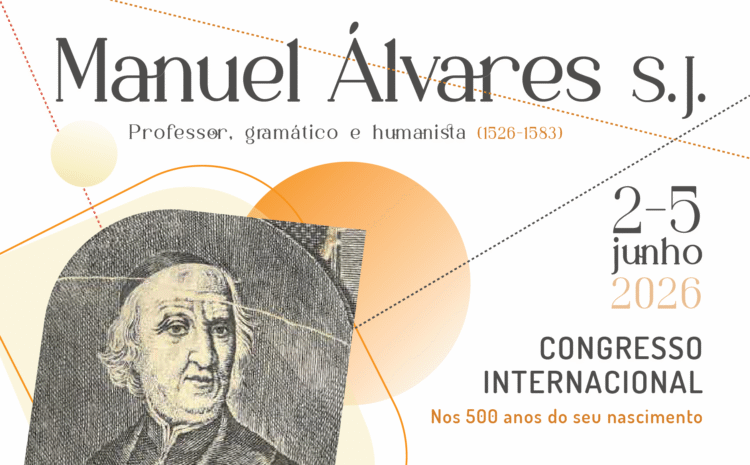
The 4th of June 2026 marks the 500th anniversary of the birth of one of the most influential figures in the history of European and worldwide grammar: Father Manuel Álvares, S.J. (1526–1583), a native of Ribeira Brava, on the island of Madeira. Author of the famous Latin-Portuguese grammar De institutione grammatica libri tres, first printed in Lisbon in 1572, Álvares is recognized as the most important Latin grammarian of the Modern Age, having his work been adopted as a normative model in Jesuit schools around the world for more than two centuries.
The Alvaresian grammar, originally written in Latin, was not merely a European reference, as the most recent academic studies have shown. Its influence extended to missionary and educational contexts as diverse as Japan, Ukraine, Brazil, Mexico, Germany, India, and the territories of the former Polish-Lithuanian Commonwealth. The Amakusa edition (1594) — the first grammar printed in Japan — or its reception in Meletij Smotryc’kyj’s Slavic grammar, illustrate its transnational and transcontinental reach and the importance of grammar as a tool for linguistic, cultural, and religious mediation.
In addition to being a landmark in Latin teaching, Álvares’s work generated profound pedagogical and epistemological debates. It was subject to reformulations, abridgments, translations, and commentaries — such as the 1599 reformed version by fellow Jesuit António Velez or Bartolomeu Rodrigues Chorro’s Curiosas advertencias da boa grammatica no compendio, & exposição da Arte do padre Manoel Alvarez, em lingua Portugueza (Lisbon 1643 [1619]) — but also to vigorous criticism within the Catholic and humanist traditions themselves. From the confrontation between the Alvarists and the Sanchists in eighteenth-century Portugal to the German-language adaptations, Álvares’s grammar continuously stimulated pedagogical and grammatical reflection. In many countries, the name “Álvares” even became, by antonomasia, synonymous with “grammar.”
The celebration of the 500th anniversary of the grammarian’s birth is, therefore, a unique opportunity to revisit critically the monumental reception of his work in light of current paradigms in linguistic historiography, missionary linguistics, and the history of education. The conference, to be held in his hometown of Ribeira Brava, at the school which proudly bears his name, intends to bring together experts from different countries and disciplines, promoting a space for interdisciplinary dialogue on the pedagogical, cultural, historical, and linguistic projections of Álvares’ legacy.
This conference, held under the patronage of the Regional Government of Madeira, the Municipality of Ribeira Brava, the Faculty of Arts and Humanities of the University of Madeira, Padre Manuel Álvares Primary and Secondary School in Ribeira Brava, the Center for Classical and Humanistic Studies (CECH), and the Center for Studies in Letters (CEL), aims not only to honor an internationally renowned historical figure from Madeira, but also highlight the central role of language, schooling/education, and grammar in the construction of cultures and identities. More than a memorial celebration, this meeting will be a moment of research and debate around one of the most enduring monuments of Western linguistic pedagogy.